ELO ratings give every player a number that reflects their skill level. Win against someone rated higher than you, your rating goes up significantly. Lose to someone rated lower, it drops.
Originally developed for chess, ELO has become the standard for individual competitive sports. Here's how it works in squash.
The Basic Concept
Every player starts with a rating — often 1000 or 1500 as a baseline. After each match, both players' ratings adjust based on:
- The result — who won
- The rating difference — how far apart the players were before the match
- The K-factor — how much ratings can move per match
The system is zero-sum: points gained by the winner equal points lost by the loser.
The Formula
The ELO calculation has two parts:
1. Expected Score
Before the match, the system calculates each player's probability of winning based on the rating gap.
Expected Score = 1 / (1 + 10^((Opponent Rating - Your Rating) / 400))
If you're rated 1500 and your opponent is 1300:
- Your expected score: ~0.76 (76% chance to win)
- Their expected score: ~0.24 (24% chance to win)
2. Rating Adjustment
After the match, ratings update:
New Rating = Old Rating + K × (Actual Score - Expected Score)
Where:
- Actual Score = 1 for a win, 0 for a loss
- K = the maximum points that can change hands (typically 20-32)
Example:
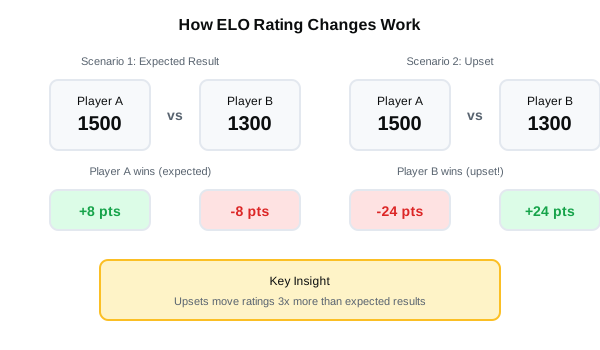
You (1500) beat your opponent (1300). K = 32.
- Your expected score: 0.76
- Your actual score: 1 (you won)
- Adjustment: 32 × (1 - 0.76) = +7.7 points
You gain ~8 points. They lose ~8 points.
If you'd lost (the upset):
- Adjustment: 32 × (0 - 0.76) = -24.3 points
Upsets move ratings significantly. Expected results move them less.
Why ELO Works for Squash
It's self-correcting. If you're underrated, you'll beat people "above" you and rise quickly. If you're overrated, losses will bring you down.
Every match matters. Tournament, league, or friendly — if the result is recorded, your rating reflects it.
It creates fair matchups. Knowing ratings lets organisers seed tournaments properly and create balanced league groups.
Players stay engaged. Watching your number move after a close win is genuinely motivating. It gives meaning to every match, not just finals.
ELO vs Other Rating Systems
Ladder Rankings
Ladders rank players by position (1st, 2nd, 3rd). You move up by challenging and beating someone above you.
Difference: Ladders only change when you play someone directly above/below. ELO updates based on every match against every opponent.
Points-Based Rankings
Common in professional tours. Points awarded for tournament results (winner gets X points, finalist gets Y).
Difference: Points-based systems reward participation in events. ELO rewards match-level performance regardless of tournament placement.
SquashLevels
The WSF-endorsed global rating system for squash. Uses its own algorithm (not pure ELO) that factors in match scores, not just wins/losses.
Difference: SquashLevels provides a global rating pulled from multiple tournament systems. Local ELO systems (like PlayMetric's) give you real-time updates after every match, including leagues and friendlies.
Common Questions
What's a good ELO rating?
Depends on the player pool. In a typical club system:
| Rating | Level |
|---|---|
| 800-1000 | Beginner |
| 1000-1200 | Intermediate |
| 1200-1400 | Club competitive |
| 1400-1600 | Strong club player |
| 1600-1800 | Elite amateur |
| 1800+ | Professional level |
These are relative to your local pool. A 1400 in one system isn't directly comparable to 1400 in another.
How many matches until my rating is accurate?
Roughly 10-15 matches. New players' ratings are provisional — they can move a lot in early matches before settling.
Do close matches count differently?
In pure ELO, no — only win/loss matters. Some systems (like SquashLevels) factor in game scores. Pure ELO keeps it simple: you either won or you didn't.
What if I only play weaker opponents?
Your rating will rise slowly (expected wins give fewer points) and drop heavily if you lose (upsets cost more). The system incentivises playing at your level.
Can I lose rating by not playing?
Standard ELO doesn't decay ratings for inactivity. Some systems add decay to encourage regular play.
Implementing ELO at Your Club
If you want ratings at your club:
Option 1: Build It Yourself
Spreadsheet with the formula above. Works for small groups. Becomes tedious with 30+ players and multiple events.
Option 2: Use a Platform
Tournament platforms with built-in ELO (like PlayMetric) update ratings automatically after every match. No manual calculation needed.
Getting Started
- Set everyone to the same starting rating (e.g., 1200)
- Record all competitive matches — tournaments, leagues, challenges
- Let it run for 2-3 months — ratings will sort themselves out
- Use ratings for seeding — once established, ratings make tournament draws fairer
The Bottom Line
ELO is simple, transparent, and fair. It rewards beating better players and penalises losing to weaker ones. Every match counts.
For clubs that want to keep players engaged beyond just tournaments, a rating system gives every match meaning. Players come back because they want to see their number move.
Related Reading
PlayMetric includes ELO ratings that update automatically after every match — tournaments, leagues, or friendlies. See how it works →